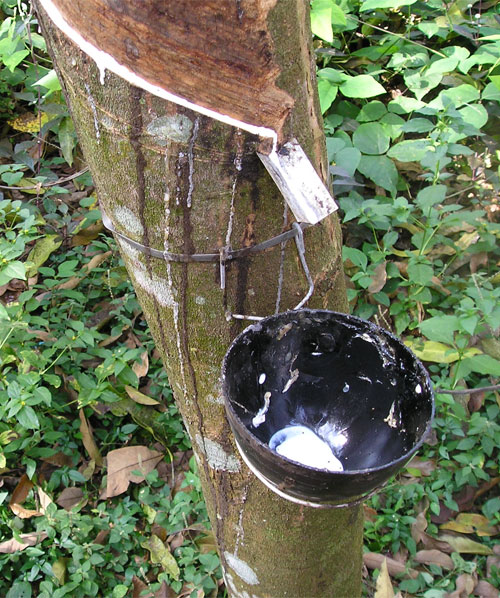
Natural rubber is an elastic hydrocarbon polymer that naturally occurs as a milky colloidal suspension, or latex, in the sap of some plants. It is used extensively in many applications and products. It can be synthesized.
The major commercial source of natural rubber latex is the Para rubber tree, Hevea Brasiliensis (Euphorbiaceae). This is largely because it responds to wounding by producing more latex.
Rubber latex is extracted from rubber trees. The economic life period of rubber trees in plantations is around 32 years - 7 years of immature phase and about 25 years of productive phase. The soil requirement of the plant is generally well-drained weathered soil consisting of laterite, lateritic types, sedimentary types non-lateritic red or alluvial soils.
The latex can be either collected in its liquid state, in which case ammonia solution can be added to the collecting cup prior to tapping in order to prevent natural coagulation, or it can be left in the field to coagulate into a cup lump. Latex is generally processed into either latex concentrate for manufacture of dipped goods or it can be coagulated under controlled, clean conditions using formic acid. The coagulated latex can then be processed into the higher grade technically specified block rubber such as TSR3L or TSRCV or used to produce ribbed smoke sheet grades.
Naturally coagulated rubber (cup lump) is used in the manufacture of TSR10 and TSR20 grade rubbers. The processing of the rubber for these grades is basically a size reduction and cleaning process in order to remove contamination and prepare the material for the final stage drying. The dried material is then baled and palletized for shipment.
Close to 21 million tons of rubber were produced in 2005 of which around 42% was natural. Since the bulk of the rubber produced is the synthetic variety which is derived from petroleum, the price of even natural rubber is determined to a very large extent by the prevailing global price of crude oil. Today Asia is the main source of natural rubber, accounting for around 94% of output in 2005. The three largest producing countries (Indonesia, Malaysia and Thailand) together account for around 72% of all natural rubber production.
The use of rubber is widespread, ranging from household to industrial products, entering the production stream at the intermediate stage or as final products.